

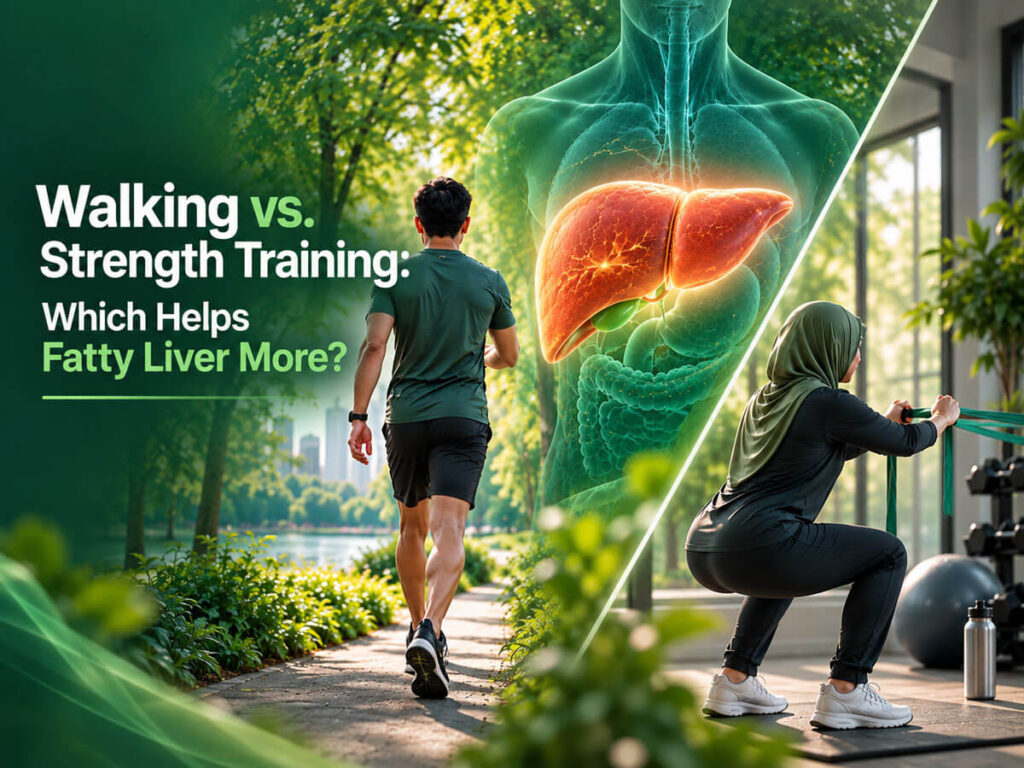
You want to do something about your fatty liver, and you know exercise deserves a place in your day. But where should you put your effort? Walking vs Strength Training for Fatty Liver , or both?
Perhaps you already walk every morning and wonder whether that is enough. Or you are helping a parent get started and want a routine they can manage.
Brisk walking and strength training can both help reduce liver fat. Human trials support both approaches, but do not establish one as the best choice for everyone.
Let us look at what each offers and how to choose your next step.
This guide focuses on metabolic fatty liver, commonly called MASLD. The studies below use the older term NAFLD.
Walking vs Strength Training for Fatty Liver at a Glance
Walking is an aerobic activity. Strength training asks your muscles to work against resistance, such as your body weight, bands, or weights.
What to consider | Walking | Strength training |
Main emphasis | Building aerobic fitness | Building muscle strength |
Liver-fat evidence | Brisk walking has shown benefits in a human trial | Resistance training has shown benefits in human trials |
Practical starting point | A manageable route near home or indoors | Suitable bodyweight or resistance-band movements |
Equipment | Supportive footwear and a safe space | Equipment depends on the exercise; a gym is optional |
What to build gradually | Duration, frequency, and pace | Technique, repetitions, and resistance |
Both deserve consideration. The research helps explain why.
What Happened When People With Fatty Liver Walked Regularly?
Brisk walking reduced liver fat in a randomised trial involving 220 adults with abdominal obesity and fatty liver.
Researchers compared three groups over 12 months: brisk walking for 150 minutes weekly, jogging followed by a walking programme, and a control group.
Both exercise programmes reduced liver fat compared with control. The difference between the exercise groups was not statistically significant. Much of the benefit appeared to be linked to weight loss.
So, if you thought exercise only counts when it leaves you exhausted, this study offers encouragement.
But pace matters. Brisk walking usually makes you breathe faster while still allowing conversation; singing becomes difficult. NHS activity guidance
If you currently walk slowly, begin there. Build towards a suitable pace as your ability improves.
What Can Strength Training Add?

Does strength training make you picture a heavy barbell?
It can begin much more simply. Rising from a sturdy chair, pushing against a wall, or using a resistance band may be appropriate starting movements, depending on your ability.
There is liver-specific evidence too. In a small controlled study, eight weeks of resistance exercise produced a 13% relative reduction in liver fat without weight loss. Hallsworth and colleagues, 2011
That does not mean 13 percentage points, or that everyone can expect the same result. The study was small and short.
Still, it answers an important worry: the weighing scale does not capture every possible benefit of exercise.
Learn the movements first. Ask for help choosing an appropriate level, then increase the challenge gradually.
Does Research Show That One Works Better?
A direct comparison found liver-fat improvements with both aerobic and resistance training, without establishing a clear winner.
The RAED2 liver-fat analysis included 31 sedentary adults with type 2 diabetes and fatty liver. Participants trained under supervision three times weekly for four months.
Both groups reduced liver fat and improved insulin sensitivity. However, aerobic sessions included treadmills, cycling, or elliptical machines. This was not exclusively a walking study. Researchers also did not assess changes in liver scarring through biopsy. Bacchi and colleagues, 2013
That distinction matters when discussing walking vs strength training for fatty liver. These findings support both options; they cannot tell every patient which activity will produce the greatest improvement.
Combining them is a practical way to address aerobic fitness and strength. These trials do not prove that the combination removes the most liver fat.
Choose Your Starting Point
If you are currently inactive, choose an activity you can manage and repeat. A short walk may feel more approachable than an unfamiliar exercise session.
If you already walk regularly, keep that useful habit. Review your duration and pace, then consider learning suitable strength exercises.
If pain, poor balance, or another condition limits you, get help adapting the plan. Your starting point should reflect your health.
Perhaps you are reading for your father or mother. Ask what makes exercise difficult. Are they worried about pain? Do they need company?
“Shall we do this together?” can make starting feel easier.
How to Fit Both Into an Ordinary Week

General adult guidance recommends working towards at least 150 minutes of moderate activity weekly, plus muscle-strengthening activity on at least two days. These are targets to build towards, not a compulsory first-week workload. NHS recommendations
For someone already comfortable with regular activity, an adaptable example is:
- Saturday, Monday, Wednesday, Thursday, and Friday: 30 minutes of brisk walking.
- Sunday and Wednesday: strength exercises suited to your ability, covering the major muscle groups.
If that feels far beyond you, begin with shorter sessions. Increase gradually, and break up prolonged sitting during the day.
With cirrhosis, significant heart problems, or substantial mobility limitations, agree on an individual plan with your clinician.
If you take insulin or medicines that can cause low blood sugar, discuss exercise precautions, especially around fasting. Do not adjust medication yourself. NIDDK hypoglycaemia guidance
How Will You Know Your Effort Is Helping?
Notice whether everyday tasks become easier and whether you are exercising more consistently. These are useful signs of functional progress.
Assessing liver health needs appropriate follow-up. Feeling fitter does not confirm that liver fat or scarring has resolved.
At JK Lifestyle, exercise sits alongside healthy food, sufficient sleep, mental peace, and individually appropriate fasting. Give your routine attention beyond the exercise session too.
Questions About Walking and Strength Training
Is walking alone a worthwhile start?
Can strength training help without weight loss?
Can I do both on the same day?
Do I need a gym to choose between walking vs strength training for fatty liver?
Build on What You Can Do Today
The practical answer to walking vs strength training for fatty liver begins with your next manageable step.
Keep the habit you have. Learn what you can add. For help choosing activity suited to your health and routine, speak with the JK Lifestyle team.
