

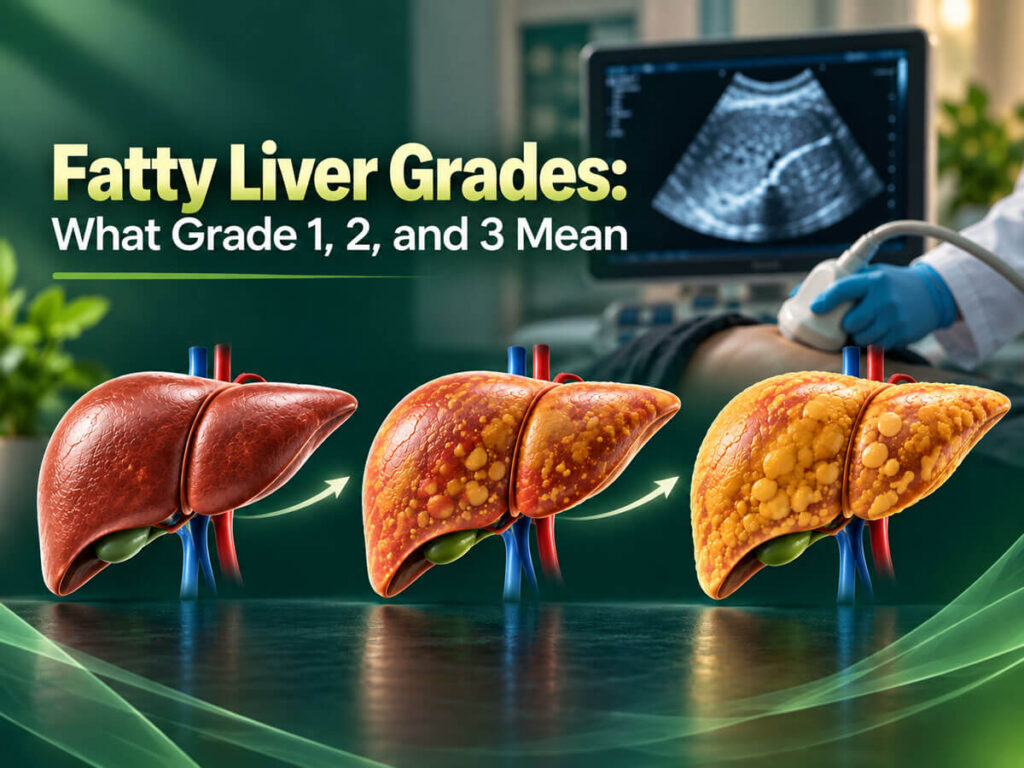
Your ultrasound report says “fatty liver”. Beside it is a grade: 1, 2, or 3.
You read it again. Perhaps you feel perfectly well. Perhaps someone has already frightened you with stories about liver failure.
What does that number actually mean? And what should you do now?
Fatty liver grades describe mild, moderate, or severe fatty changes seen on an ultrasound. They do not, by themselves, tell you how much scarring your liver has. Understanding that distinction helps you approach your report calmly. Ultrasound evidence and limitations
Let us go through it together.
Fatty Liver Grades at a Glance
Fat accumulation inside liver cells is called steatosis. On a conventional ultrasound, this can make the liver appear brighter and its deeper structures harder to see.
The commonly used fatty liver grades describe these appearances:
Ultrasound grade | Usual meaning | Typical appearance |
Grade 1 | Mild fatty changes | Slightly increased brightness; blood vessels and the diaphragm remain clearly visible. |
Grade 2 | Moderate fatty changes | Greater brightness; blood vessels and the diaphragm become less distinct. |
Grade 3 | Severe fatty changes | Marked brightness; deeper structures, blood vessels, and the diaphragm are poorly seen. |
These are visual categories. A routine ultrasound grade does not provide an exact percentage of liver fat, and interpretation has limitations. How ultrasound assesses fatty liver
What Does Your Grade Mean for You?
Grade 1: give it attention early.
You might think, “It is only mild. I will deal with it later.”
Use the finding as a reason to review your health now. “Mild fatty changes” describes the scan; further assessment determines what those changes mean for you.
Grade 2: look at the whole picture.
Moderate fatty changes deserve follow-up. Bring your previous reports and discuss your blood sugar, blood pressure, cholesterol, medicines, and daily routine.
Two people with Grade 2 may need different care.
Grade 3: arrange assessment without assuming the worst.
The word “severe” understandably feels frightening. But Grade 3 describes severe fatty changes on ultrasound. It does not automatically mean cirrhosis or liver failure.
Across all fatty liver grades, a fuller assessment helps establish the risk of liver damage. NIDDK diagnostic guidance
Does Grade 3 Mean Cirrhosis—and Does Grade 1 Rule It Out?

Neither conclusion follows from the grade alone.
There are different things to understand:
- Steatosis: excess fat in liver cells.
- Steatohepatitis: fat accumulation accompanied by inflammation and liver-cell injury.
- Fibrosis: scar tissue in the liver.
- Cirrhosis: advanced scarring that changes the liver’s structure.
Some people develop inflammation and progressive scarring, but this is not an inevitable journey for everyone with fatty liver. NIDDK explanation of fatty liver disease
A lower fat grade cannot independently exclude significant scarring. Equally, a higher fat grade does not establish it.
That is why comparing your number with a neighbour’s report can mislead you. Your care needs to reflect your own findings.
What Should You Do After Receiving the Report?
Start by arranging a clinical review. Take the ultrasound report, earlier blood tests, and a list of medicines and supplements.
Your clinician may review metabolic health, alcohol intake, and other possible causes of liver disease. Blood tests can help assess liver injury and identify conditions needing treatment.
Depending on your circumstances, a clinician may use FIB-4, which combines age and certain blood-test results, to assess the likelihood of advanced scarring. An elastography test such as FibroScan measures liver stiffness and may help investigate further. Not everyone needs every test. NIDDK guidance on assessment
Here is a useful question to take to your appointment:
“Have we assessed the possibility of scarring as well as the liver fat?”
Before leaving, make sure you understand your next step and when to return.
Can Fatty Liver Improve From Here?

There is reason for hope. Liver fat can decrease, and appropriate treatment can improve liver health. Where weight loss is needed, gradual, sustained weight loss can help; physical activity also offers benefits even without weight loss. NIDDK treatment guidance
Now look at an ordinary day.
Does breakfast include sweet tea and biscuits? Does rice fill most of your lunch plate? How much time passes without getting up from your chair?
Choose changes you can repeat. Reduce sugary drinks. Give vegetables and suitable protein a proper place in meals. Review oversized portions. Begin moving regularly at a level you can manage. NHS lifestyle guidance
JK Lifestyle’s approach considers healthy food, exercise, sleep, mental peace, and individually appropriate fasting. Think about how these fit your responsibilities and health.
Fasting needs particular care if you take insulin or medicines that can cause low blood sugar. Discuss changes with your clinician before skipping meals or adjusting medication. NIDDK guidance on fasting and low blood sugar
You do not have to rebuild your whole routine overnight. Start with a manageable change and build consistency.
How Do You Know Whether You Are Improving?
Feeling more energetic is encouraging. Still, feeling better alone cannot confirm what has happened inside your liver.
Follow-up may include weight or waist measurements, blood sugar, cholesterol, liver blood tests, and reassessment of scarring risk when appropriate.
Changes in fatty liver grades can contribute to that picture. However, a lower ultrasound grade does not prove that existing scarring has disappeared. Ultrasound also has measurement and interpretation limitations. Evidence on ultrasound limitations
Keep your reports together. Agree with your clinician which findings to track and when to review them.
Common Questions About Fatty Liver Grades
Can I have fatty liver without symptoms?
Why might two ultrasound reports show different grades?
Is there a Grade 4 fatty liver?
How long does improvement take?
Understand Your Grade and Take the Next Step
Your report gives you a starting point. You can ask questions, understand what needs assessment, and begin caring for your liver through everyday decisions.
Tonight, choose one practical change. Then make sure your follow-up appointment is arranged.
For help adapting your food choices and routine to your health, speak with the JK Lifestyle team.
