

Your fasting timer reaches 16 hours. You have heard that this is when your body starts “cleaning its cells”. But what is autophagy, and can a clock tell you when it happens?
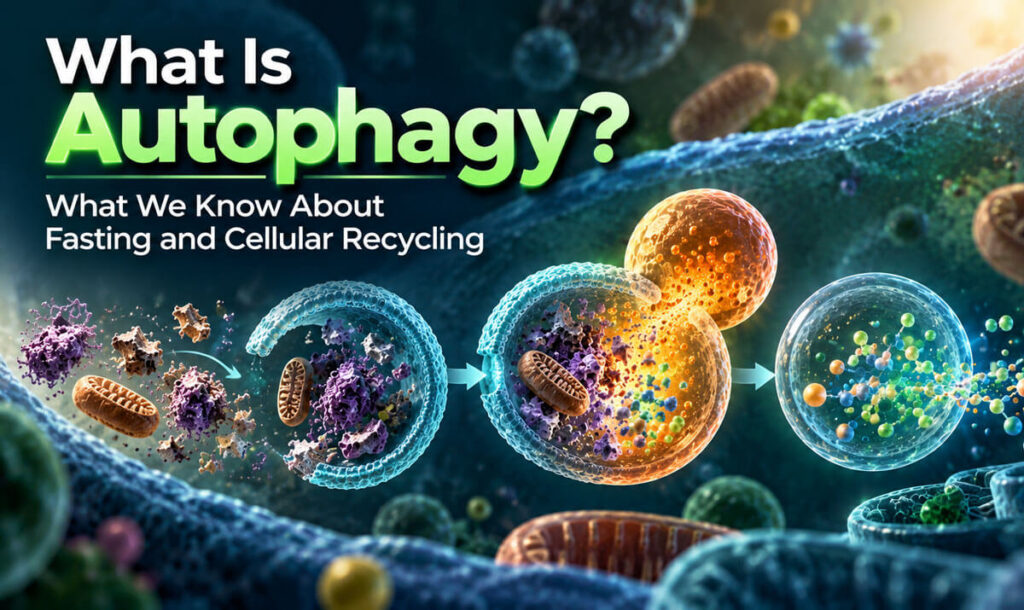
Autophagy is a natural process that allows cells to break down and recycle their own components, including worn or damaged parts. It helps cells maintain themselves and reuse valuable materials. Nobel Prize explanation
Fasting can influence this process. Understanding the connection begins with something remarkable your cells already do, and recognising what a fasting timer cannot measure.
What Is Autophagy Doing Inside Your Cells?
Think of a busy workshop. Tools wear out. Parts become damaged. Keeping everything running takes maintenance alongside new supplies.
Your cells face a similar challenge.
During one major form of autophagy, a membrane surrounds cellular material. The resulting structure joins with a compartment called a lysosome, where enzymes break the material into smaller pieces. The cell can reuse these pieces for energy or to build new components.
That is what “cellular recycling” means. Much of this work happens inside individual cells.
Discoveries explaining the mechanisms of autophagy earned Yoshinori Ohsumi the 2016 Nobel Prize in Physiology or Medicine. His work helped reveal how cells recycle their contents and adapt when nutrients become scarce. The Nobel Assembly’s account
This gives us a useful starting point: your body already has cellular maintenance systems. The next question is how fasting affects them.
Where Fasting Comes In
Cells respond to the nutrients and energy available to them. When those supplies change, their internal signals change too.
During fasting, reduced nutrient availability can encourage cells to make greater use of their existing resources. Autophagy is part of this response.
However, understanding a biological mechanism does not immediately tell us how long a person should fast. Researchers must also establish what happens in humans, which tissues respond, and whether those changes produce meaningful health benefits.
This distinction matters when you see a fasting chart promising a precise sequence of benefits.
A chart can organise information. It cannot show what is happening inside your cells at that moment.
Does Autophagy Start After 16 Hours?

There is no established universal hour when autophagy switches on throughout the human body.
Autophagy takes place as part of normal cellular maintenance. Fasting may change its activity, and different tissues may respond differently.
Statements such as “autophagy starts at 16 hours” are therefore more precise than the evidence allows. Animal experiments cannot provide a reliable human countdown. Cleveland Clinic’s autophagy overview
Your fasting app records elapsed time. It does not measure what your liver, muscles, or other tissues are recycling.
If you already follow a 16:8 routine, this does not make your effort pointless. Assess the routine through your health, nutritional needs, and ability to maintain it.
Ask practical questions. Can you eat enough during your eating window? Does the schedule fit your medicines and daily responsibilities? Do you feel comfortable following it?
Extending a fast to reach an imagined cellular milestone gives you no reliable measure of benefit.
What the Research Can Actually Tell Us
Once we move beyond “what is autophagy?”, the more difficult question is whether changing its activity through fasting improves human health.
A 2025 exploratory analysis studied 121 adults with obesity. Researchers compared standard care, calorie restriction, and a programme combining intermittent fasting with time-restricted eating.
They measured autophagic flux in certain blood cells. This describes the movement of material through the recycling process.
At six months, the fasting programme showed a favourable difference in change compared with standard care. The finding may partly reflect declining activity in the comparison group. There was no significant difference between groups at two months. The human study
This is an interesting clue, with clear limits.
It does not establish a fasting threshold, reveal what happened in every organ, or prove that participants will live longer. A change in a cellular measurement also does not automatically show that a disease has improved.
Those outcomes require their own evidence. Keeping that distinction clear helps us appreciate the research without turning an early finding into a treatment promise.
How This Fits into Your Everyday Lifestyle
At JK Lifestyle, fasting sits alongside healthy food, exercise, sleep, and mental peace. These five pillars encourage us to consider the whole day.
Start with the routine you can realistically maintain.
Does your eating window leave enough room for nourishing meals? Does it fit your work and bedtime? Are you comfortable with the schedule, or spending the day anxious about food?
If fasting is suitable for you, plan what you will eat as carefully as when. Build meals around vegetables, appropriate protein sources, and other foods that meet your individual nutritional needs.
Think ahead about ordinary obstacles. A late meeting, a family meal, or a change in your work shift may require flexibility. A useful routine should help you navigate daily life.
Keep movement and rest in the picture. Make time to unwind too. Each habit deserves attention without needing to call it an “autophagy booster”.
Discuss regular fasting with a clinician, particularly if you have diabetes or kidney disease, are pregnant or breastfeeding, are underweight, or have a history of eating disorders. Some medicines require food or adjustments you should not make yourself. Cleveland Clinic’s fasting guidance
A Few Questions Before You Try It
Can you tell when your body is in autophagy?
Does black coffee stop autophagy?
Is autophagy the same as ketosis?
Can autophagy happen without fasting?
Your Health Is Bigger Than a Fasting Timer
Understanding “what is autophagy?” gives you a clearer view of how your cells maintain themselves. It also helps you recognise when a fasting claim goes beyond the evidence.
Consider what your routine is helping you achieve. Enough nourishment, manageable habits, and appropriate follow-up give you something practical to build on.
You can take care of your health while science continues to answer the finer questions.
For help deciding whether fasting fits your health, medicines, and daily routine, speak with the JK Lifestyle team.
